Tooling is the largest irreversible cheque in a toy launch. What the quote actually contains, why cavity count decides your unit economics, and the ownership clause almost nobody reads.
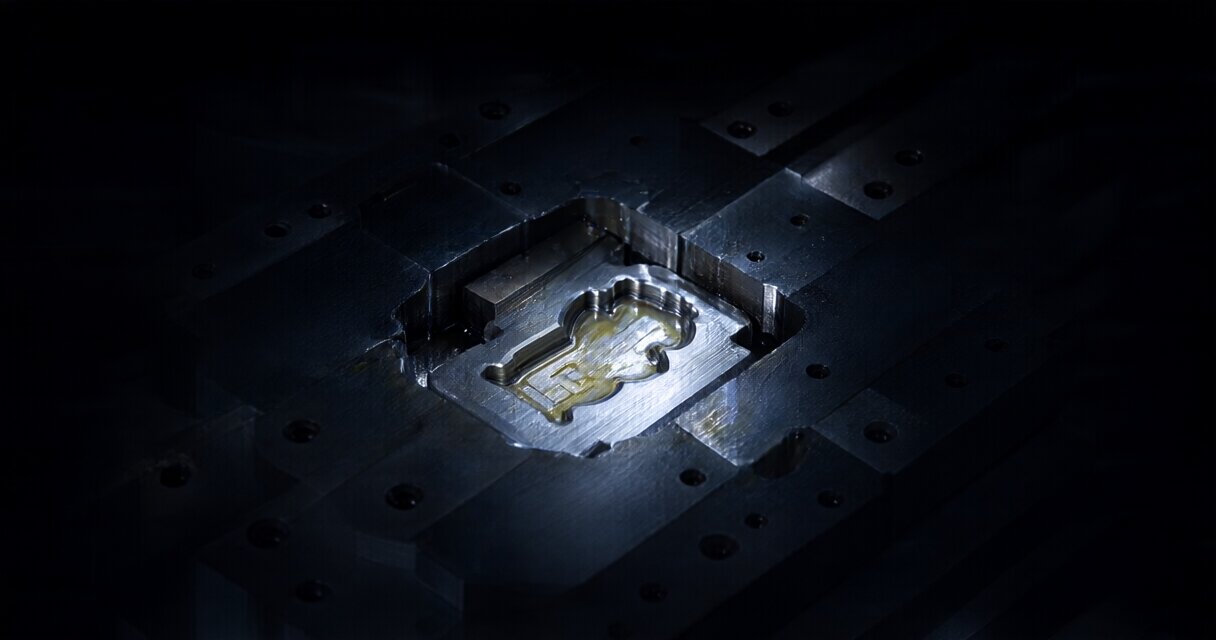
A toy factory will quote you a unit price in a day. The tooling quote takes a week, arrives as a single number with no breakdown, and is the one line item where you cannot recover your money if the product fails.
That asymmetry is why tooling is where first-time brand owners get hurt. They negotiate the unit price down by four cents and accept a tooling quote without opening it. Then they discover the tool has two cavities when they needed four, that it was cut in a soft steel rated for a fraction of their volume, and that they do not legally own it.
This is the article I wish every buyer read before signing a tooling PO: what a mould physically is, the three grades you can buy, what makes one quote double another, how cavity count changes your unit economics, and how to structure ownership and amortization so the money is recoverable.
A mould is a precision assembly of machined steel plates, and every element in it corresponds to something you can specify — and something a supplier can cheaply omit.
When a factory quotes "$8,000 for the mould," they are quoting a specific configuration of all six. If the quote does not state cavity count, steel grade, runner type and whether there are sliders, it is not a quote — it is a placeholder.
Broadly, there are three things you can buy, and the price gap between them is real because the steel and the labour are different.
| Grade | Typical steel | Tool life (indicative) | Cost band | Lead time | Use it for |
|---|---|---|---|---|---|
| Prototype / soft tool | Aluminium or soft steel, single cavity | Hundreds to a few thousand shots | Lowest — often a fraction of a production tool | Short | Market test, trade show samples, fit and feel checks. Bridge only. |
| Standard production tool | Pre-hardened P20 / 718H class, multi-cavity | Hundreds of thousands of shots with maintenance | Mid — the normal Chinese export tool | Medium | Most toy SKUs at normal volumes. This is the sensible default. |
| Hardened / export-grade tool | H13, S136, NAK80 class, hardened inserts, sometimes hot runner | Well into seven figures of shots | Highest — often two to three times the standard tool | Longest | High volume, abrasive or corrosive material, tight tolerance, long product life |
Two notes. First, "tool life" numbers from a supplier are usually the steel's theoretical capability, not what you will get — actual life depends on the material you run, the tonnage, the cooling and whether anyone maintains the tool. Second, a hardened tool is not automatically better. If your volume is 20,000 units, a hardened tool is a way to spend three times as much for a benefit you will never use.
The most common tooling mistake I see: a soft tool bought for a "test launch" that becomes the production tool because the launch went well and nobody budgeted the second mould. Soft tools fail in exactly the way that ruins a good quarter — degrading ejector pins, flash appearing mid-run, dimensions drifting. If there is any realistic chance of reordering, buy the production tool.
Eight variables explain almost all of the variance between two quotes for the same part.
Ask for the quote broken down by these eight lines. A supplier who cannot break it down has not engineered it — they have estimated it by weight, and you will find out which parts were underestimated at T1.
Cavity count is a volume decision, not a quality decision. Here is the arithmetic, using a 120-gram ABS part as an illustration: 32-second cycle, machine and operator cost of roughly $38 per hour, material at about $0.42 per shot. Those assumptions are illustrative — your factory's numbers will differ — but the shape of the curve is universal.
| Tool | Tool cost (illustrative) | Moulding cost / part | Total unit cost @ 10k | @ 50k | @ 100k | @ 200k |
|---|---|---|---|---|---|---|
| 1 cavity | $6,500 | $0.76 | $1.41 | $0.89 | $0.82 | $0.79 |
| 2 cavity | $9,500 | $0.38 | $1.33 | $0.57 | $0.47 | $0.43 |
| 4 cavity | $16,000 | $0.19 | $1.79 | $0.51 | $0.35 | $0.27 |
| 8 cavity | $28,000 | $0.10 | $2.89 | $0.65 | $0.37 | $0.23 |
The break-even points fall out of that table, and they are the most useful numbers in this article:
The rule: match the cavity count to the volume you will realistically order in eighteen months — not the volume in your business plan. Buying cavities for volume you never reach is the most common way to overpay for tooling; buying one cavity short is the most common way to lose margin on a product that works.
There is also a quality argument the table does not show. More cavities means more chances for cavity-to-cavity variation. On a cosmetic part with a tight colour match, a four-cavity tool needs the runner balanced and the cooling even, or you will ship containers where the left-side parts are subtly different from the right. If your product is highly cosmetic, modest cavity count with good toolmaking beats high cavity count with a fast toolmaker.
You paid for it. That does not automatically mean you own it, and it certainly does not mean you can move it.
The three things that have to be written into the tooling agreement:
Ownership. The tool is your property, identified by a tool number, held by the factory as bailee for production of your orders only. Not "the tool is developed for the customer" — a sentence that describes an intention rather than a title. State that you own it, that it must be marked with your tool number, and that it may not be used to produce goods for anyone else.
Access and transfer. You can inspect it, photograph it, and remove it on request, with the factory obliged to pack and release it. Without this clause, a factory can hold your tool as leverage in a pricing dispute — and in most cases they are legally entitled to, because possession is the practical reality.
The refundable-tooling trap. "We will refund the tooling cost against your first 50,000 units" sounds generous. It usually means the tool cost is quietly loaded into the unit price, and if you never reach 50,000 units you have paid for both. Ask what the unit price would be if you paid the tool separately at cost. The difference is the real interest rate on that "free" tooling.
Cheap protection: ask for a photograph of the tool with your tool number stamped on the steel, and a copy of the tool drawing. Both cost nothing, and both convert a verbal understanding into something a lawyer can use.
A new tool does not produce saleable parts on the first shot. It produces a trial, and the trial is a scheduled event you should attend — physically or by video.
T1 (first trial). The tool is assembled and run for the first time. Expect short shots, flash, sink marks, warpage and dimensional drift from shrinkage. This is normal. What you are looking for is whether the tool design is right: do the sliders move cleanly, does the part eject without dragging, is the gate in a place that leaves an acceptable mark.
Steel correction. Between T1 and T2 the toolmaker adjusts — adds steel where it flashed, removes steel where it short-shot, changes the gate, adjusts cooling. This is where the schedule either holds or slips, and where a supplier who underestimated the part discovers it.
T2 (second trial). Parts should be close to dimensional spec and cosmetically acceptable. This is the sample you measure, assemble, and — if it is an electronic product — fit the electronics into.
Approval and freeze. Sign off on a golden sample and freeze the drawing. Any change after this point is a tool modification, and a tool modification is a two-to-four week schedule hit plus a cost.
Budget two to four weeks between T1 and T2 on a straightforward part, longer if there are sliders, a texture, or an insert. If your supplier promises a first trial and mass production inside three weeks on a complex multi-part product, they are either very good or planning to ship you parts that fail inspection. Assume the second until proven otherwise.
This is why the tech pack matters so much. A tool is cut to the drawing you approved, and if the drawing is ambiguous the toolmaker resolves the ambiguity their own way — usually the fastest way. Our tech pack guide covers what has to be in it.
There are three common ways to account for tooling, and they produce very different pictures of whether a product is profitable.
| Method | How it works | What it is good for | Where it misleads |
|---|---|---|---|
| Charge to first order | Full tool cost sits in the first PO | Cash truth. You see exactly what you spent. | Makes a viable product look unviable at low first-order volume |
| Amortize over planned volume | Tool cost divided by expected lifetime units | Product P&L, pricing decisions | Hides the fact that the cash went out on day one, and assumes volume you may never reach |
| Amortize over confirmed volume only | Tool cost divided by the units actually on order | Conservative pricing; protects margin if the product is discontinued | Makes the first order's margin look terrible, which is the honest answer |
The method that keeps companies solvent is the third one for pricing, with the second one used only as a planning view. Price the first order as if the tool will never be used again. If the margin only works when you assume 100,000 units, the product has a tooling problem, not a pricing problem.
Worked example. A tool costs $16,000. Landed unit cost excluding tooling is $2.10. Your target wholesale price is $6.00.
Same tool, same part, wildly different business. This is why the honest question at concept stage is not "what does the tool cost" but "what is the smallest first order that still makes the tool affordable" — and then designing the product and the channel to clear that number. Our MOQ guide covers the tactics for getting there.
Tools are consumables. They wear, and the wear is predictable.
Ejector pins bend or mushroom. Gates erode and need re-polishing. Sliders wear at the guides, which slowly changes the position of the feature they form. Cooling channels scale up, which lengthens cycles and quietly raises your unit cost.
A sensible arrangement is a defined maintenance interval expressed in shots, not in years — for example, a pull-and-inspect at every 100,000 shots, with pins and gate inserts treated as replaceable. Ask what the factory's maintenance schedule is and whether it is included or billed. If the answer is "we maintain it when there is a problem," your tool will be maintained when it has already produced a bad batch.
Keep a golden sample from the first approved run, sealed and dated. When quality drifts two years later, that sample is the only objective reference that settles the argument about whether the tool has moved or the material has changed.
Not every toy should begin with a mould, and the calculation above gives you the test: if your realistic first-year volume is under roughly 5,000 units and the part is geometrically simple, a tool may be the wrong first purchase.
Three alternatives worth pricing before you commit:
Tooling is not a cost you negotiate; it is a decision you engineer. Cavity count should follow your real eighteen-month volume, steel grade should follow your real total shots, and the tool should be your property with a transfer clause that works when the relationship does not.
The number on the quote is the least important part of it. What matters is the configuration behind the number, and whether you priced your first order as though the tool would never be used again. Do both, and the tool stops being a gamble.
Send us the part drawings, target volume and material. We will come back with a cavity recommendation, a broken-down tooling cost, and an honest break-even volume — including whether you should cut a tool at all.
Request a Tooling Review →